A junior facilitator watches a senior one for a few months and notices something uncomfortable.
Week one, a participant talks well past their time and the senior cuts in almost immediately. Week three, nearly the same thing happens and the senior lets it run all the way out. Nothing obvious separates the two situations.
So the junior starts building a manual. Situation on the left, action on the right. When someone dominates airtime, redirect after a few minutes. When the room goes silent, ask an opening question. It grows week by week, and it feels like progress.
Most serious practitioners do a version of this, and it is the right instinct for that stage. You cannot read a room you have no reference points for, and rules give you somewhere to stand while you build them. The problem is not that the notebook is a mistake, but it is rather the notebook is meant to be a temporary tool, and is to be put down at some point.
Manuals don't survive the swampy lowland
Take that one moment, someone talking too long, and pull it apart. What are they actually trying to say? How does the team see this person? What happened in this room last week? How much time is left? Is the long speech covering for someone else? Is this the first time today they have spoken at all?
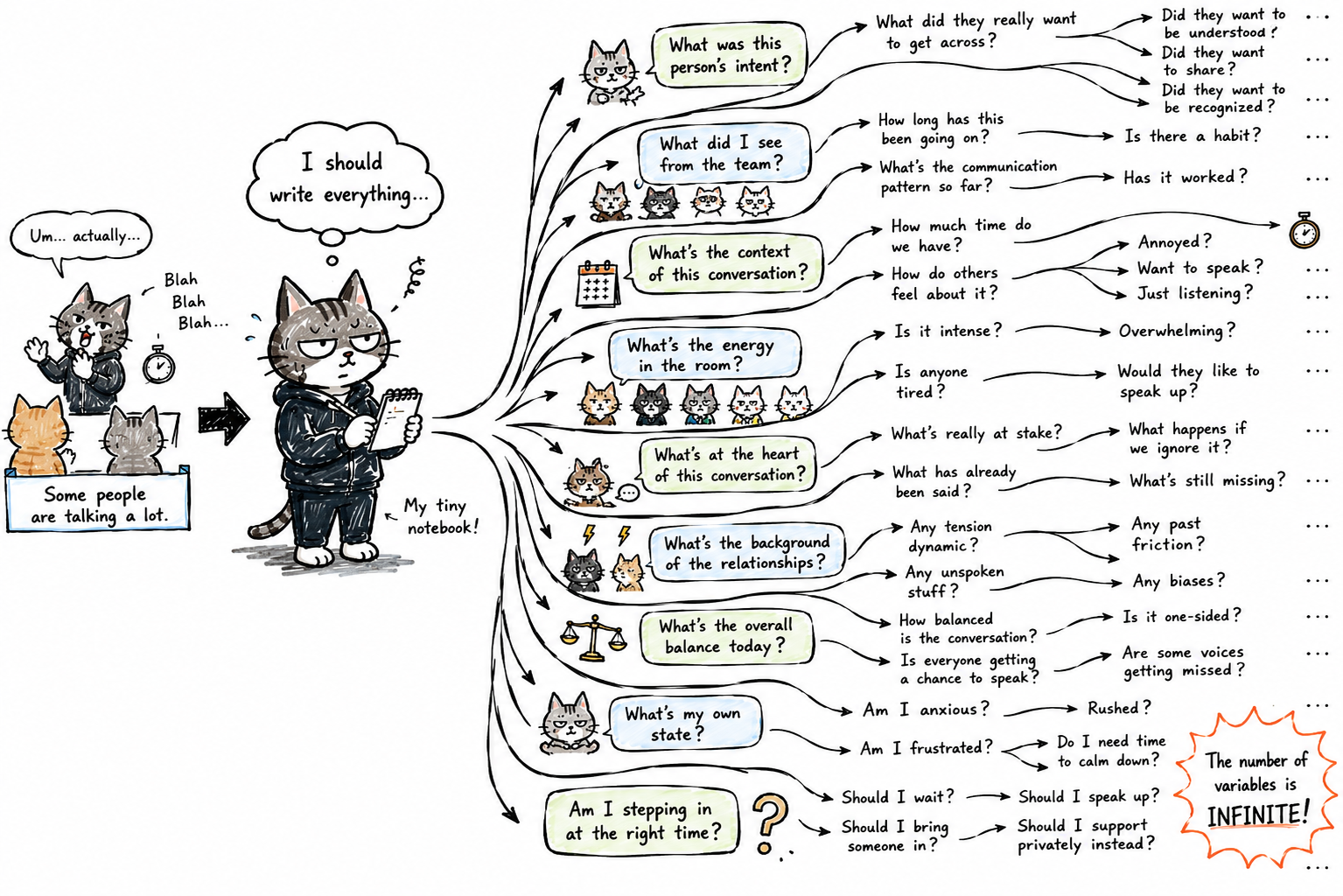
Change one variable and the right move changes with it. The combinations do not run out.
Donald Schön drew the distinction that matters here. Some problems sit on high, hard ground, where research-based technique resolves them cleanly. The rest sit in what he called the swampy lowland, where problems are messy and confusing and refuse technical solution. His warning was that in the swamp, technical rationality is not merely insufficient. It can become a liability.
Facilitation lives almost entirely in the swamp. And the liability shows up in a specific way: the thicker the manual gets, the less the practitioner watches the room. Attention goes to retrieving the matching row instead of noticing what is happening in front of them. For this kind of work, that is not slow progress. It is going backwards.
The Principles, Intent, Intervention model
You cannot memorize all the possible combinations, but you can hold what actions come from.
The sequence runs: hold principles, use them to form an intent for this specific moment, and let the intent guide the decision or intervention.
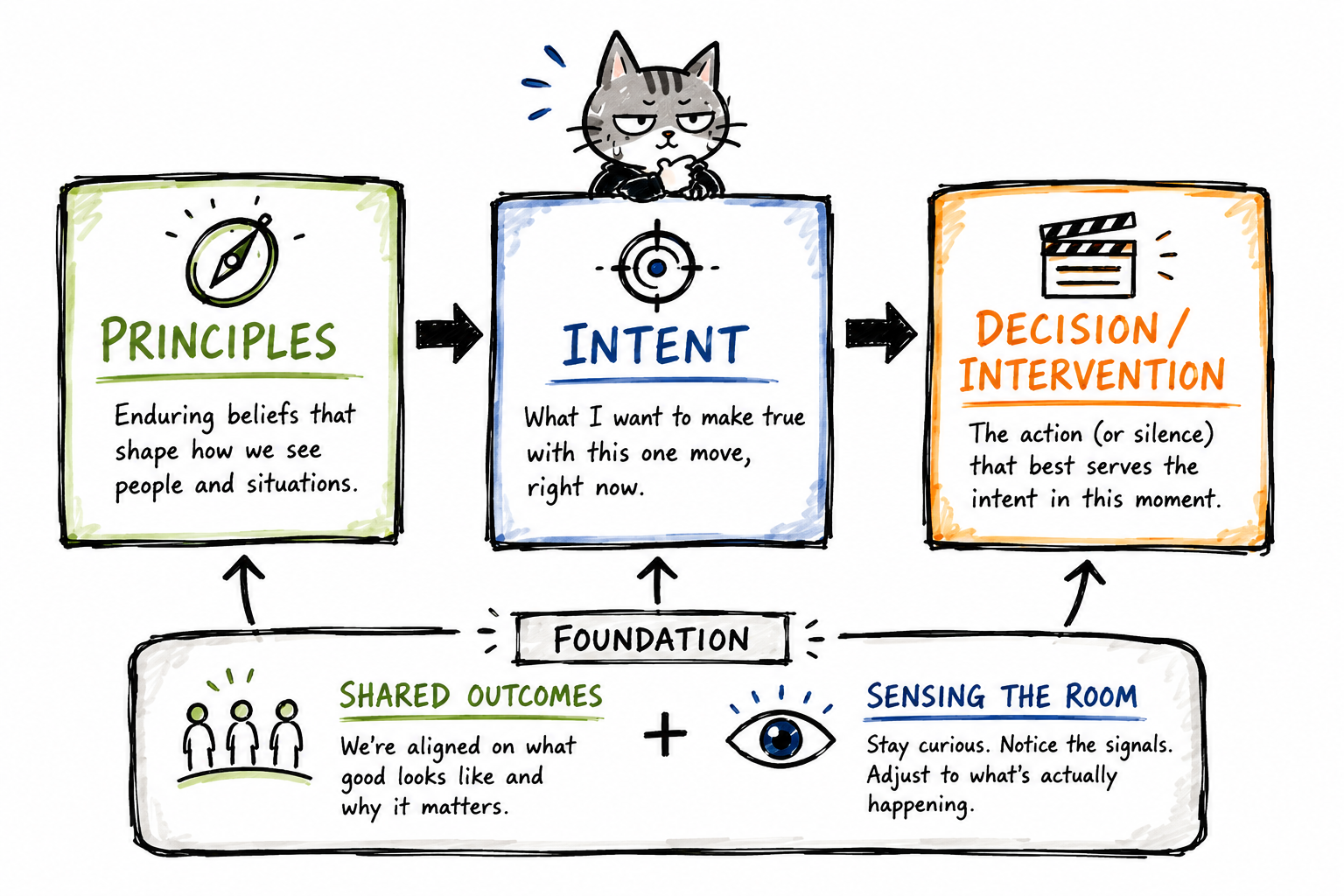
Principles do not specify behavior. That is exactly why they survive infinite situations.
Some examples of the shape, though the content has to be yours:
- People only act on answers they found themselves.
- Silence is often movement, not a stall.
- The most important thing in the room is usually sitting next to the thing nobody wants to say.
None of these tell you what to do. All of them change what you see when you walk in.
Intent is not purpose
Principles do not hand you an answer. They let you form an intent.
Purpose is what you want to achieve in the end. It sits some distance away. Intent is what you want to make true with this one move, right now, close in.
Go back to the two weeks. The senior's principle was the same both times: people only act on answers they found themselves.
Week one, the intent was to keep more than one voice alive in the room, because others were visibly giving up on speaking. That produced space for other perspectives to emerge.
Week three, the intent was to protect the time someone needed to reach words they had not yet found. That produced silence and waiting.
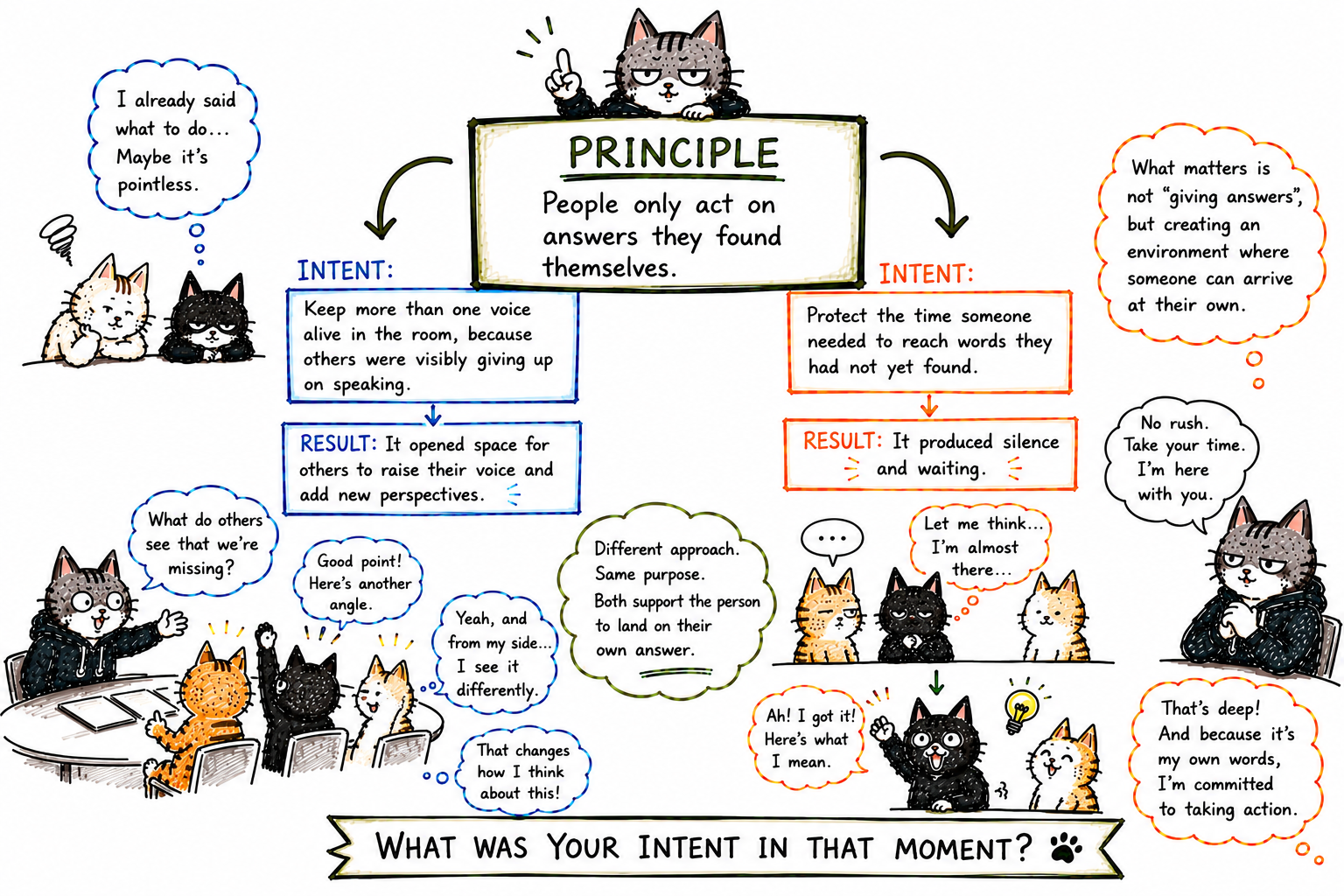
One principle, opposite actions. The inconsistency only exists at the level of behavior. One layer down, it holds.
Manual vs intuition
Gary Klein spent years studying fireground commanders, emergency nurses, and military officers, and found something that complicates everything above. Experts in those settings do not weigh options against each other. They recognize the situation as one they have met before, and act on the first workable response that recognition throws up. What looks from outside like intuition is a very large library of accumulated patterns.
Read that way, the manual is not the wrong idea at all. It just goes implicit, grows past anything you could write down, and stops being retrievable as rows on a page. Keep going long enough and the manual becomes you.
So why not simply accumulate cases and wait?
Because of a condition Klein and Daniel Kahneman settled on together in 2009, after years of public disagreement about whether expert intuition deserves any trust. Their conclusion was that it does, but only when two things hold. The environment has to be regular enough to contain valid cues. And the practitioner has to receive feedback that is both fast and unambiguous.
A fireground commander finds out within ninety seconds whether the call was right. Our work fails both conditions. Rooms are irregular, and the feedback from an intervention arrives weeks later, filtered through a dozen other causes, if it arrives at all. Where those conditions fail, confident pattern-matching does not mature into expertise. It becomes error that feels exactly like expertise.
That is the real reason this craft needs an explicit layer that firefighting can do without. We cannot rely on the patterns to teach us quietly, because our patterns are not being corrected. We have to be able to say what we were doing, and put it where someone can check it.
Bring visibility to the intent
"Why didn't you stop it?" has no useful answer, you would usually get "it depends," which sends the junior back to slicing their categories finer. Another row in the manual.
The better question is: what were you trying to make true in that moment?
That one can be answered. And the answer transfers, because intent is not welded to the situation the way an action is.
The same responsibility runs the other way. Senior practitioners are hard to learn from because they narrate nothing. Schön called this knowing-in-action, the kind of competence that lives inside the doing, where practitioners routinely know more than they can say. The intervention is visible; the intent behind it is not. Anything invisible cannot be picked up by observation, so juniors copy the only thing on offer, which is the behavior.
Ryo did the opposite of this in アジャイルコーチはレトロスペクティブの何を見ているのか, where he laid out what he is actually watching for during a retrospective instead of just running one. That is the move: dragging the invisible layer into words so someone else can work with it.
Saying it out loud costs almost nothing. "I waited because I wanted her to get there in her own words." One sentence, and what transfers changes completely.
Principles cannot be borrowed
You could take the three principles above and carry them into your next session. They probably will not work.
Principles come out of a specific person's values and vision. What you care about, what kind of space you want to create, what kind of practitioner you are trying to be. Principles are those things translated into a form you can decide from. When the source material is not yours, no real intent forms, and without intent you are back to guessing.
So the conclusion is unavoidable: developing your own principles requires self-exploration. Not as a nice addition to the craft. As the precondition for it.
The fastest route in is backwards. Take three recent interventions where you hesitated before choosing. For each, write what you were protecting, not what you did. Then write what you gave up. What you refused to give up is where the value sits. Do three and the same word tends to surface more than once.
Two important prerequisites you need
Principles and intent are not sufficient on their own. Two conditions carry them.
Shared desired outcomes. Intent means something because it points at an outcome. If that outcome only exists in your head, your intent is private, and to everyone else your interventions look improvised. Get the goal explicit and shared with everyone involved before you start making moves from it. チームの意思決定方法 covers the mechanics of agreeing this up front.
The ability to sense what is actually happening. You cannot form an intent about a room you are not reading. Who stopped breathing, whose posture changed, where the words and the face came apart. This runs on something other than analysis, and it needs its own development. 会議で使えるグループプロセスの観察ガイド is a practical entry point, and 気づきの3領域 goes at the same problem from the inside.
Principles and intent tell you how to choose a course. Sensing tells you what the water is doing. Neither one moves the boat alone.
Letting go the manual
If you are keeping that list, stop adding to it. Start a different one, from the back of the same notebook: what you were trying to make true, each time you chose. Not your senior's version. Your own.
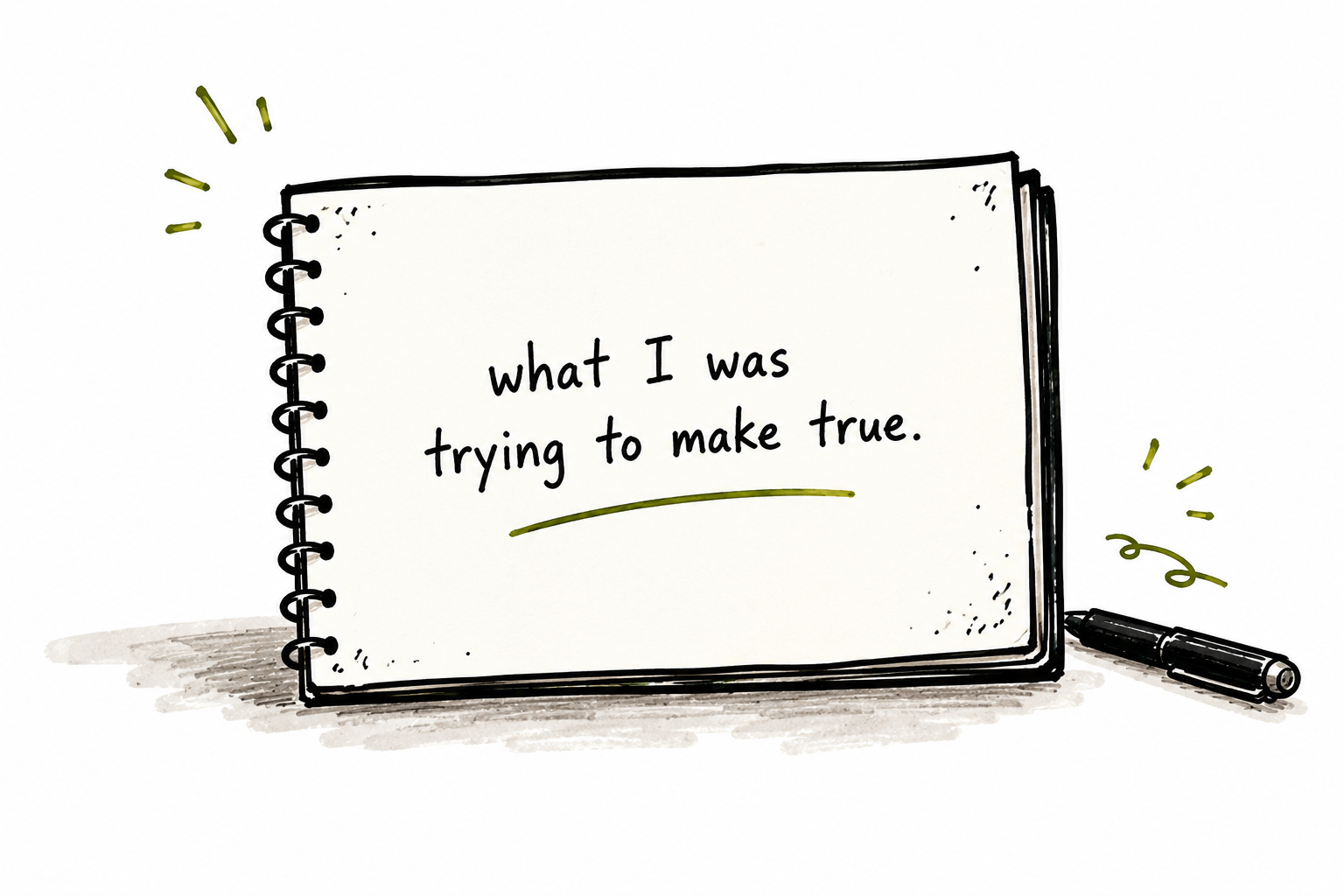
Next time you hesitate before an intervention, name what you want to make true before you reach for what to do. The hand usually follows on its own.
Further reading
- Schön, D. (1983). The Reflective Practitioner: How Professionals Think in Action. And (1987), Educating the Reflective Practitioner. The high ground and the swampy lowland, knowing-in-action, and the case against technical rationality in messy work.
- Klein, G. (1998). Sources of Power: How People Make Decisions. The recognition-primed decision model, drawn from field studies of fireground commanders and other experts under time pressure.
- Kahneman, D. & Klein, G. (2009). "Conditions for Intuitive Expertise: A Failure to Disagree," American Psychologist. Two researchers who disagreed for years working out exactly when expert intuition can be trusted, and when it cannot.